
Sullivan Projected and Actual Release
A projected date is a calculation or planning date. An actual release date records the completed departure from the relevant custody system. Those dates can match, but they answer different questions. The calculation may depend on the judgment, sentence structure, lawful credits, parole action, and other cases. The actual event depends on final checks, release authority, and the absence or resolution of holds.
A Sullivan County pretrial detainee usually has no sentence-based release date. A bond amount is not proof that bond was posted, and a scheduled hearing is not an order. Even a favorable court order may not state the time SCSO completed release. For a locally sentenced inmate, the judgment and the jail's existing computation are the best starting records. For a TDOC prisoner, read the exact sentence and release information that FOIL displays.
The distinction also prevents a transfer from being mislabeled. A person can leave the Sullivan County Jail and enter TDOC, ICE, USMS, or another county's custody. That is an end to one facility's custody, not necessarily release into the community.
Find Sullivan Projected Release Dates
Start with jurisdiction. The official SCSO roster reports current county custody but does not publish a projected-release field or historical released-person archive. FOIL covers felony offenders who are currently or formerly in TDOC custody or supervision. Court records explain the sentence and later amendments. Each channel holds one part of the answer.
- Identify whether the person is pretrial, serving a Sullivan jail sentence, or serving a TDOC sentence. Do not apply prison rules to a local jail case.
- For a TDOC person, search FOIL by TDOC ID, State ID, or name. Compare identity, status, offense, and sentence details.
- Copy the exact release or sentence date label displayed and record the lookup date. Never rename it “Projected Release Date” if FOIL uses different words.
- For a county sentence, obtain the judgment from the proper Sullivan clerk division and ask SCSO for the existing jail calculation, credit record, and release-authorizing document.
- Check for later court orders, parole action, detainers, transfers, or other holds that could change or block the expected release.
- After the expected date, verify the actual event through FOIL status, VINE, and the custodian's release record.
The FOIL interface displays name, TDOC ID, and State ID search routes.
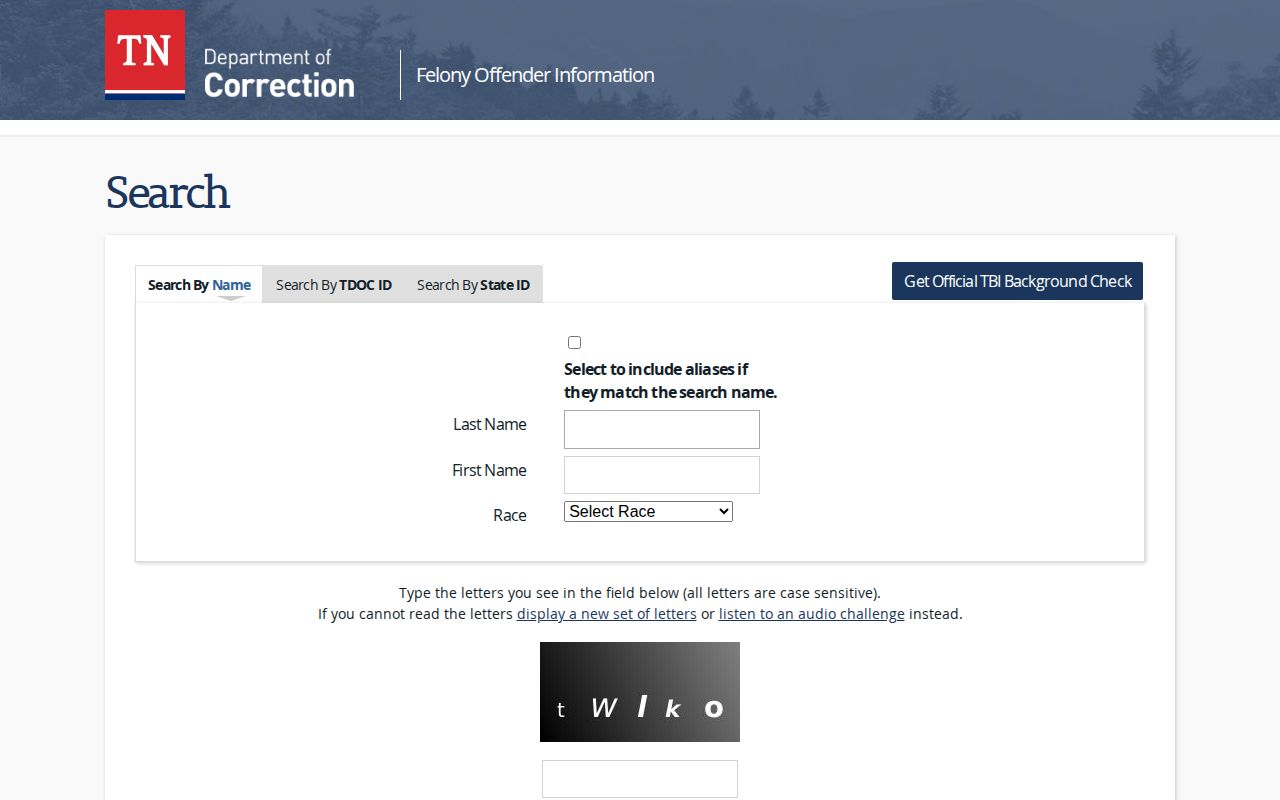
The capture supports how to reach a person record. It does not establish a universal field name or supply a release date for every result.
The official FOIL information page says sentence and release information may be available, along with status, location, offense, photo, and parole-hearing status. “May” is important. The public landing page does not promise one uniform projected-date field, so the record must be quoted with its own label.
Read FOIL status before reading any date. An incarcerated status means the person has not left TDOC custody. Parole indicates conditional release under supervision, while probation identifies community supervision that may have begun through a court sentence. Inactive identifies a former TDOC record but does not state a universal reason for departure. If FOIL says inactive, compare the sentence and release details actually shown with the court judgment. Do not silently convert the category into sentence completion.
Sullivan Release Date Source Map
The office holding the record depends on the case stage. Asking SCSO to explain a TDOC calculation, or asking TDOC for a county booking release time, sends the request to the wrong custodian. Use this division before calling or filing a records request.
| Situation | Best planning source | Actual-release proof |
|---|---|---|
| Sullivan pretrial detention | Court docket, bond, and order | SCSO inmate-file date, time, and authorizing document |
| Local jail sentence | Judgment and SCSO's existing computation | SCSO release entry and authorizing record |
| TDOC prison sentence | FOIL's exact sentence/release fields and TDOC calculation | FOIL status/release data plus TDOC or VINE event |
| Parole consideration | Board eligibility and hearing records | Final action plus later TDOC/VINE release status |
| Other-agency hold | Detainer and receiving-agency record | Release from each relevant custody system |
A current county roster disappearance cannot supply a date. Sullivan's release policy even allows a person expected to return from another jurisdiction's court to be released out of the computer when gone more than 24 hours. Request the detainer, transfer, and return record when the destination is unclear.
Note: General weekday office hours for the Sullivan County Jail are not release hours and do not predict when final processing will end.
Sullivan Truth-in-Sentencing Rules
Tennessee's release framework cannot be reduced to “everyone serves 85 percent.” Public Chapter 988, the 2022 Truth in Sentencing Act, applies to qualifying offenses committed on or after July 1, 2022. It created listed offense groups requiring 100 percent service and other listed groups for which credits cannot reduce service below an 85 percent floor. It did not create one rule for every person in prison.
The correct analysis begins with the offense date, conviction offense, judgment, and offender classification. Tennessee Code section 40-35-501 governs release eligibility with offense-specific and date-specific rules. Section 41-21-236 governs sentence-reduction credits. The judgment and TDOC calculation apply those provisions to a specific sentence. A short rule of thumb can be wrong when the conviction date, offense group, or sentence structure differs.
Credits may affect a date only when the law permits them. Minimum-service rules and exclusions still control. A credit calculation also does not erase a detainer or second judgment. Read the date as one part of the full custody record.
What Changes Sullivan Release Dates
A projected date can move before release. Some factors change the sentence calculation itself. Others leave the calculated date in place but prevent physical departure. The difference should be kept in the record notes because a delayed release and a recalculated date are not the same event.
| Factor | Possible effect | Record to check |
|---|---|---|
| Credit award, loss, or restoration | Moves a lawful calculation where credits apply | TDOC or jail credit record |
| Amended judgment | Changes sentence terms or credit | Certified court order and new calculation |
| Consecutive or concurrent sentences | Changes how terms combine | Judgments and TDOC sentence record |
| Parole decision | May permit conditional release, but eligibility or a hearing does not | Board final action, FOIL, and VINE |
| Detainer, warrant, or new case | Can block community release or cause transfer | Hold, court, and receiving-agency records |
| Disciplinary action | May affect available credit under governing rules | Agency disciplinary and calculation records |
Parole has several separate milestones: eligibility, hearing, recommendation, final decision, and physical release. The Board's hearings description explains that a hearing officer's recommendation is nonbinding and Board members make the decision. A grant can still be rescinded before departure.
Sullivan County Sentence Calculations
Do not transplant TDOC prison-credit rules into a Sullivan County jail sentence without proof they govern that case. Ask for the jail's existing computation, the judgment, any jail-credit record, and the document authorizing release. The county need not create a new explanation or custom calculation, but it can provide existing public records subject to lawful limits.
SCSO's release procedure requires the inmate file to retain the release date, time, and a copy of the authorizing document. Staff also check warrants, other charges, sentences, holds, and wants before completing release. Those steps explain why a mathematical end date is not the same as a gate time.
The court and jail records serve different roles. A judgment sets the legal sentence, and a later amended judgment can change it. The jail's computation applies the relevant local rules and credits in its custody system. The release file then records the completed act. Ask for existing documents rather than requiring staff to produce a new narrative. Useful targets include the judgment, any existing calculation or credit sheet, the recorded release date and time, the authorizing document, and any detainer or transfer entry.
No Sullivan-specific weekend or holiday early-release rule was established in the official sources reviewed. If a calculated date falls on a nonbusiness day, call the jail and ask about the existing calculation and procedure. Do not promise a Friday release. Likewise, no official public exit point, waiting area, regular gate time, or transport procedure was found.
Sullivan Parole Dates Need Proof
The Tennessee Board of Parole posts weekly hearing schedules, usually updated Monday or Tuesday after a Monday holiday. A schedule shows planned consideration, not release. Hearing officers make recommendations, and the Board applies the required vote. No distinct public statewide decisions-results database was found in the researched Board pages.
FOIL may show parole-hearing status and later a parole status. “Parole” supports conditional release from prison when the identity and as-of date match. It does not mean the sentence is discharged. Record the status, location, and sentence information, then use the Sullivan District 10 field office for procedure. If the need is the physical release date, obtain the displayed release information or TDOC discharge record instead of substituting the hearing date.
A look at Sullivan County parole and probation verification helps separate a Board milestone from active community supervision and formal discharge.
Confirm Sullivan Actual Release Dates
Registering with VINE can provide notice of a reported custody event. Select Tennessee, find the correct person, inspect the source agency, and choose the notification option. An alert is strong evidence that the reporting agency transmitted an event, but it may need more detail to distinguish community release from transfer. A missing result proves nothing.
For a county detainee, pair the event with SCSO's inmate-file release date, time, authorizing document, and any transfer record. For a TDOC prisoner, pair it with FOIL status and TDOC release information. Preserve the alert wording and timestamp. The detailed VINELink inmate check covers the registration and identity steps.
Actual release closes the calculation question. It does not necessarily close the sentence, because parole, probation, federal supervision, or another custody system may follow.